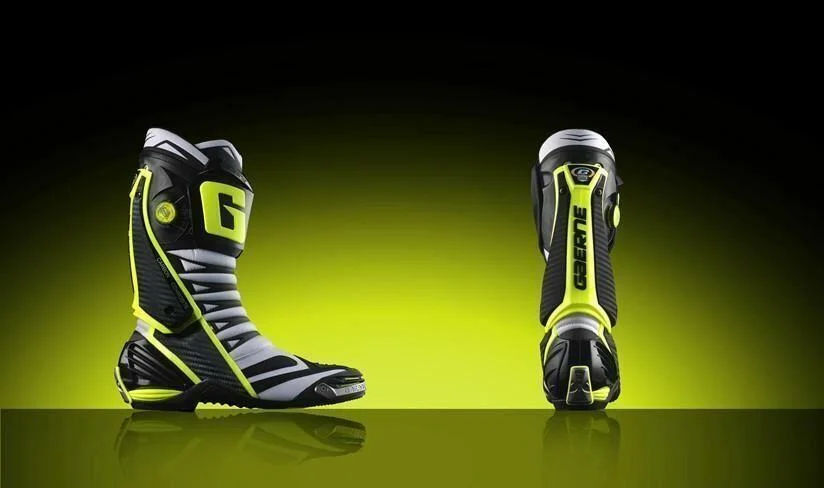
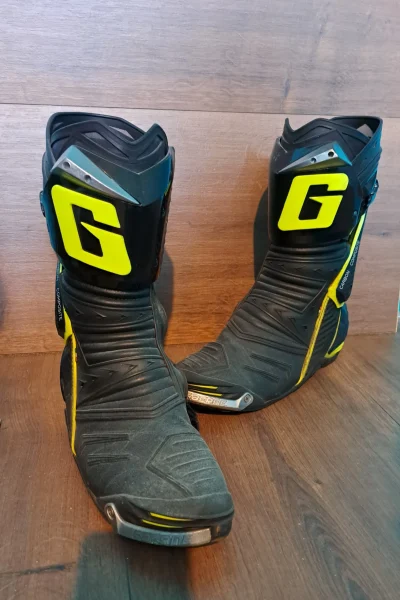
I picked up my Gaerne GP1 Evo boots at a sale in 2023 and have used them as my standard set of motorcycle boots ever since. After more than two years of using the Gaerne GP1 Evo, the price-to-quality ratio was definitely worth it. However, the GP1 Evos do come with a few drawbacks. It’s important to note that these are the older model, with the ratcheting closure for correct sizing, rather than the newer models that feature Gaerne’s adjustable closure system with a BOA IP1 dial. I tried this closure system on in 2025, and it fits considerably better. The new model seemed to offer more support, either due to adjustments in the design or because the boot was still new.
The GP1 EVO boot is CE-certified according to EN 13634:2017 and Regulation EU 2016/425. And, according to Gaerne, the GP1 EVO boot is “proudly made in Italy.“
High-performance boot with points of concern
The Gaerne GP1 EVO racing boots are part of the Gaerne Racing line. These flagship models are the result of close collaboration between Gaerne R&D and professional riders, clearly demonstrating the brand’s commitment to innovation, safety and high performance within the European motorcycle market.
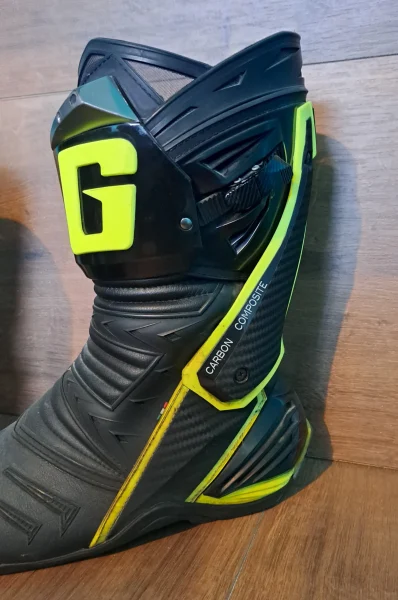
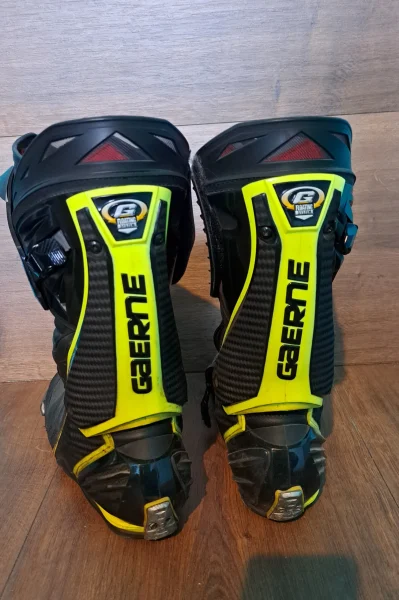
The Gaerne Floating Pivot System GFPS, made from carbon composite, provides additional lateral support and helps prevent compression and hyperextension. This system helps to keep the rider’s foot in a natural position on the footpeg. The carbon GFPS runs down both sides of the boot and is secured with a simple screw to a second carbon composite protective plate that extends all the way to the sole of the boot.
At the rear, the GFPS comes together in a supportive protective plate, giving the boot a very solid and secure feel while also contributing to its visually striking design. Unfortunately, this construction also introduces a drawback. If the screwed pivot point is not lubricated regularly, ideally using a silicone spray, it will start to produce noise. This results in an irritating squeaking sound while walking. It will be particularly noticeable for riders who ride in all conditions, as rain and wet weather require even more frequent lubrication. With proper maintenance this is not a major issue, but the squeaking is personally a minor irritation.
The Gaerne GP1 Evo features an adjustable calf closure system. On my current boots this is still a ratchet closure, similar to those commonly seen on off-road boots. The newer GP1 Evo models are equipped with a replaceable BOA IP1 closure. This adjustable system allows for a customized fit, making the boot suitable even for riders with larger calf sizes.
The older ratchet closure tightens the entire shin protection, consisting of a replaceable PU-injected shin plate that is anatomically shaped for robust support. This provides a fit that is comparable to the newer BOA IP1 system. The disadvantage of the ratchet system is that adjustability is limited to the preset steps of the ratchet. The BOA IP1 system is a more premium adjustable closure that offers a far more personalized fit and can easily be fine-tuned between every ride. This type of closure is increasingly seen across major motorcycle brands, both on boots and on gloves.
The closure system is completed by an internal zip that works in combination with an elastic insert around the ankle, making the boot easier to put on and close. In my experience, the zip is easy to operate even while wearing gloves and has proven durable over time. A rubber flap covers the zip and is secured with hook and loop fastening, allowing it to be tightened as firmly as desired. The rubber Grip Guard also protects the leg from heat generated by the motorcycle and exhaust.
The lightweight upper is constructed from microfibre, a high-tech material developed for excellent abrasion resistance. Elastic inserts ensure a snug fit, provide a high level of comfort and support natural forward and backward movement. Naturally, a PU gear shift protector is included for maximum feel while shifting and additional reinforcement.
Inside, the boot is fitted with a breathable lining and strategically designed ankle padding with varying thicknesses for maximum comfort. These components appear to be highly wear-resistant and have proven comfortable in use. The boots have never caused real discomfort, even during motorcycle rides exceeding 400 kilometres or a full day walking around a motorcycle exhibition. They are equipped with a removable and washable anatomically shaped insole. While the insole is somewhat firm, it retains its shape very well and provides full support across all areas of the foot. It should be noted that frequent washing will naturally accelerate wear.
The sole features a multi-density profile with different grip zones and a tread pattern that is integrated into the upper. This design ensures excellent grip on footpegs and control components, combined with improved durability against abrasion and contact with asphalt. Unfortunately, my boots do show visible wear on the sole. This is to be expected after extensive use, but the wear appears to have developed more quickly than on the Losail Evo boots I used previously.
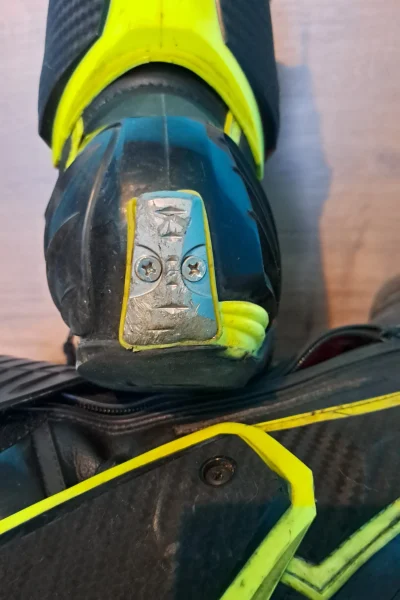
The Gaerne GP1 Evo is equipped with replaceable magnesium sliders on both the toe and heel, designed to allow smooth sliding when in contact with the asphalt. The toe sliders are widely available on the market and are interchangeable between different Gaerne models. They are also mounted more securely than those on the Losail Evo, which was one of the major drawbacks of that model.
The heel sliders, however, present the opposite experience. On multiple occasions, one of the mounting screws was lost, causing the slider to rotate or catch. I have tried several alternative bolts, but this remains a recurring issue. At the time of writing, it is unclear whether this problem also affects the newer models. The positioning of the sliders is, however, a positive aspect. Wear patterns on my boots clearly show that they are actively used during more enthusiastic riding. Currently, the heel sliders are secured using coarser bolts combined with thread locking compound, which appears to be working better. I do not expect to replace the sliders before replacing the boots entirely. The fact that the heel sliders show significant wear, and therefore frequently come into contact with the asphalt, may well contribute to the screws working loose over time.
Lorica: light, durable and functional
As I ride year-round, I have used the GP1 Evo boots in temperatures above 30 degrees as well as below freezing. The GP1 Evo provides sufficient wind protection and remains pleasantly warm in colder conditions, without immediately creating a sauna effect on warmer days. This is partly due to the use of Lorica in the boot. Lorica is a high-quality synthetic microfibre that offers exceptional strength and durability. It looks and feels like premium leather, yet provides additional technical advantages, making it an excellent choice for the demanding use of a motorcycle boot in the European motorcycle market.
An additional advantage is that Lorica requires minimal maintenance and can easily be cleaned with soap and water up to 40 °C, without any loss of quality or appearance. This makes it ideal for all-season riders, as rinsing off sand, road grime and salt is quick and easy. Lorica repels water, oil and stains, ensuring long-lasting cleanliness with minimal effort. Unfortunately, it does appear that the front section of the GP1 Evo boots, possibly due to their flexibility, is not completely waterproof. It is not to the extent that the boot fills with water during heavy rain, but during prolonged wet conditions the front seems to allow some moisture to pass through. As a result, the upper part of the foot and the transition towards the shin become damp, which is certainly less comfortable during the colder months.
Lorica is approximately 40 percent lighter than leather, which makes these motorcycle boots feel noticeably less heavy. This is particularly beneficial on longer rides or on days when you are also walking around in your motorcycle boots. This combination of flexibility and durability is ideal for a high-quality motorcycle boot. Especially for riders who cover many kilometres and want to use their purchase for more than one season. Lorica retains its softness and shape over time, whereas leather can become stiff or crack as it ages. In addition, it is 100 percent vegan and chrome-free, making it suitable for riders who value ethical sourcing alongside safety and durability.
Gear shifting is made easy thanks to the shape and flexibility of the motorcycle boot. The anatomically shaped polyurethane gear reinforcement ensures that shifting feels almost effortless, without losing the essential touch with the gear lever. Operating the rear brake is equally precise. What I personally appreciated most were the shock-absorbing heel inserts and the gel pad around the ankles. These provide excellent support during long rides, spirited riding, or even when you are off the bike.
Conclusion
The Gaerne GP1 Evo motorcycle boots have a clean and sporty appearance, something that has been further improved in the newer models. The design of the boot is refined and well considered. This contributes significantly to the overall comfort level of the GP1 Evo. In all situations, I experienced the GP1 Evo as very pleasant to wear, comfortable yet robust, making it well-suited to sporty road riding within the European motorcycle market.
Yes, the heel protection where the screws can come loose is not ideal. Removing it is the simplest solution of course, although using better quality screws also works. This should certainly not be a reason to avoid purchasing the Gaerne GP1 Evo. The lack of strong waterproof performance could be a consideration, but according to feedback this has been further improved in the newer models. Ideal.
Overall, the impression is very positive. The different colour options are a bonus, as is the addition of the BOA IP1 dial system, which makes the boot especially appealing to me. It is a Gaerne product, so the price in the Dutch and wider European market is slightly higher. At the time of writing the new GP1 Evo model is priced between €350 and €450 in the Netherlands, depending on the retailer and colour option.

Meer Posts
LS2 Advant X FF901 (2023)
IM866 INBIKE motorhandschoenen (2023)
Losail Evo Laarzen van Bogotto (2023)